
1. Introduction: A Pivotal Moment for Hong Kong’s Economic Future
Hong Kong stands at a critical juncture. While our economy has demonstrated notable resilience, with a projected real growth rate of approximately 2.9% per annum through 2029, the SME sector must navigate significant headwinds from escalating geopolitical fragmentation and secular economic transitions. This submission outlines a strategic framework for the 2026-27 Budget designed to cultivate “new quality productive forces” and fortify the long-term sustainability and competitiveness of our business community.
Our core recommendation is for the Government to adopt a comprehensive strategy of “Steady Growth, Structural Adjustment, and Nurturing New Qualities”. This forward-looking approach is anchored in the systematic integration of Environmental, Social, and Governance (ESG) principles across the entire spectrum of business incentives, taxation policy, and financing mechanisms, creating a robust foundation for high-quality, sustainable growth.
2. Pillar I – Environmental: Accelerating a Quantifiable Green Transition
To successfully achieve carbon neutrality before 2050 and maintain our international economic relevance, it is critical to move beyond high-level aspirations toward the implementation of quantifiable application scenarios. The following policy interventions are designed to accelerate this green transition by providing businesses with tangible pathways and incentives.
Targeted Green Transformation Grants To empower SMEs to meet increasingly stringent international environmental standards, the Budget should allocate more specific and targeted funding under the BUD Fund for green transformation projects. This dedicated support will directly assist businesses in adopting sustainable technologies, upgrading processes, and aligning their operations with global green supply chain requirements.
Incentives for Sustainable Building Stock Addressing Hong Kong’s aging building stock is essential for meaningful carbon reduction. We embrace a two-pronged approach to incentivize sustainable retrofitting. First, the Budget should offer stamp duty waivers for private developers and owners’ corporations that undertake comprehensive sustainable building conversions. Second, we also suggest a regulatory “re-setting” of property age for buildings that achieve certified low-carbon standards. This policy directly addresses a major market failure where the short remaining mortgage tenors on older buildings make green retrofitting financially unviable. By “re-setting the clock,” the government unlocks private capital and creates a powerful, market-driven cycle of investment and decarbonization.
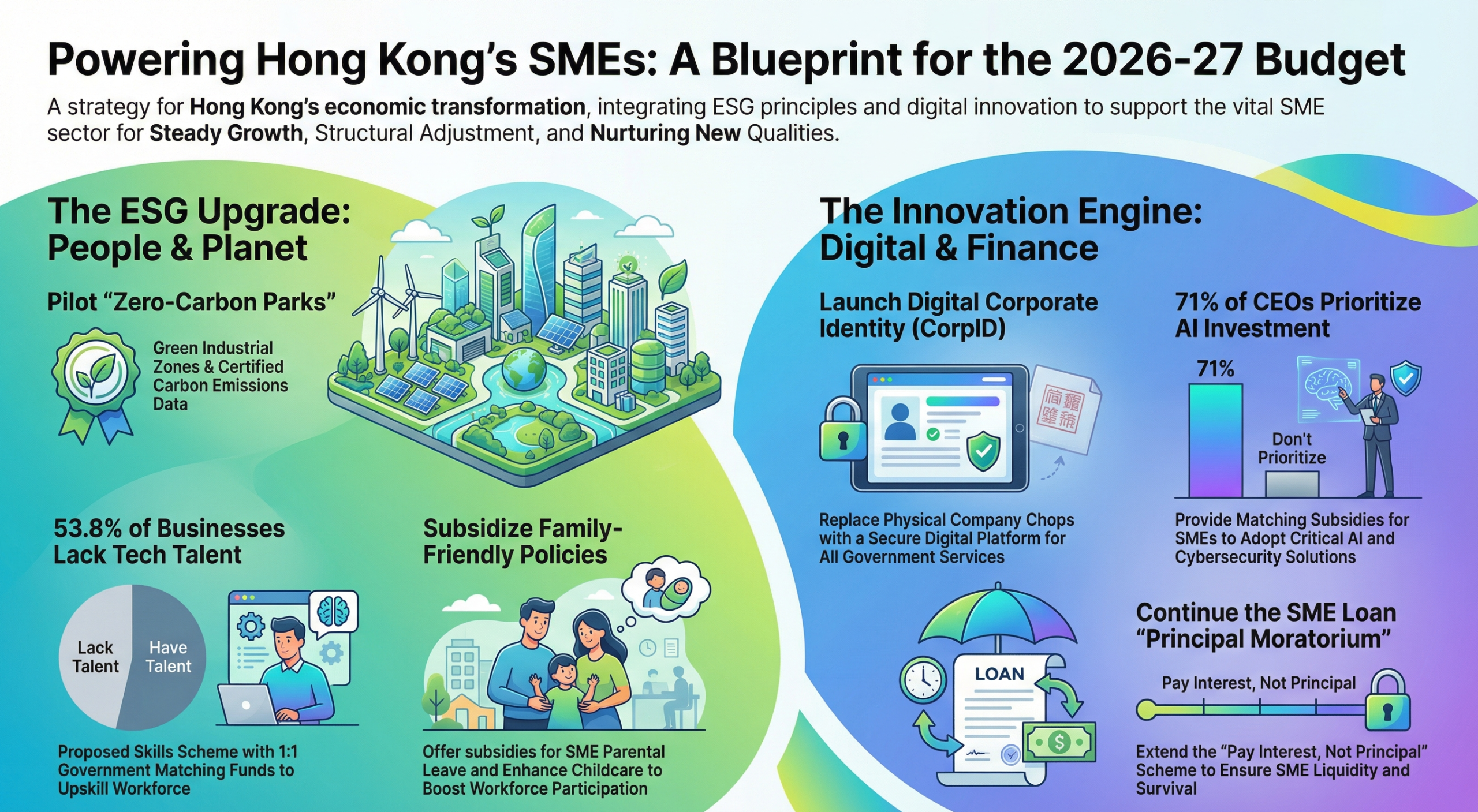
Pioneering “Zero-Carbon zone” To position Hong Kong as a leader in green innovation, the Budget must allocate resources to establish zero-carbon park zone in strategic locations such as the Northern Metropolis or the Hetao area. These specialized zones would not only provide essential green infrastructure but also offer vital carbon emission data certification services, creating an attractive ecosystem for global firms seeking to establish carbon-neutral regional headquarters.
3. Pillar II – Social: Cultivating a Future-Ready and Inclusive Workforce
The talent shortage has emerged as the primary obstacle to Hong Kong’s economic progress, with a lack of technical talent cited as a key barrier to digital and green transformation for 53.8% of surveyed businesses. Therefore, the 2026-27 Budget should strategically deploy social policy as a primary economic tool to dismantle barriers to growth by directly addressing skills deficits, talent attrition, and workforce exclusion.
The “Service Industry Future Skills Upgrading Scheme” The Budget must establish a new “Service Industry Future Skills Upgrading Scheme,” built upon a matching seed fund between the Government and trade associations. To drive employer participation, a crucial incentive must be introduced: an additional profits tax deduction for firms that hire apprentices who successfully complete the program’s certified courses.
Support for Working Families and Youth Employment Unlocking the full potential of our workforce requires robust support for working families. We recommend subsidizing SME parental leave costs to help them align with international best practices and enhancing the provision of after-school childcare services to support the female labor force. Concurrently, to stimulate broader youth employment, the successful 50:50 graduate hiring subsidy must be expanded beyond the Innovation and Technology (I&T) sector to cover a wider range of industries.
4. Pillar III – Governance: Driving Efficiency Through Digital Transformation
Full Implementation of the CorpID Platform We support that the CorpID platform be fully operational by late 2026. Its core function—enabling SMEs to use secure digital authentication and signatures for all government services and online commercial transactions—will be revolutionary.
Subsidizing AI Adoption and Cybersecurity The adoption of artificial intelligence is no longer optional. With 71% of CEOs identifying AI as their top investment priority for 2026, government support is crucial. We recommend enhancing the Digital Transformation Support Pilot Programme to provide direct matching subsidies for SMEs to adopt essential AI and cybersecurity solutions, ensuring they can compete effectively and securely in the digital economy.
5. Pillar IV – Financing: Ensuring SME Liquidity and Credit Sustainability
Accessible finance is the lifeblood of SME survival and growth, particularly during periods of profound structural economic change. The following proposals are designed to provide immediate liquidity relief while concurrently building a system that rewards long-term creditworthiness and supports strategic investment.
Enhancements to the SME Financing Guarantee Scheme Two critical enhancements are needed to support SMEs. First, we strongly urge the Government to continue the “Principal Moratorium” (還息不還本) arrangement, which provides essential breathing room for businesses managing cash flow. Second, firms that have successfully repaid their “100% Guarantee Loans” must be made eligible for waived vetting on re-borrowing applications. This measure reduces administrative friction for proven, reliable borrowers, allowing capital to be deployed more rapidly to support growth opportunities and mitigate short-term liquidity challenges.
BUD Fund Matching Loans Many SMEs struggle to meet the upfront self-contribution required to access the BUD Fund. To solve this critical bottleneck, the Hong Kong Mortgage Corporation should offer concessionary low-interest matching loans specifically to cover this self-funded portion. This will unlock the fund’s potential for a much broader range of businesses.
6. Conclusion
The strategic combination of targeted tax concessions, powerful digital governance tools, and robust financing support will serve as the “navigator and fuel” for Hong Kong’s SMEs, enabling them to sail confidently through the complexities of the global market and toward a future of high-quality growth. A strategic partnership between the Government and the business community is not merely desirable; it is the essential precondition for securing Hong Kong’s prosperous and resilient economic future.